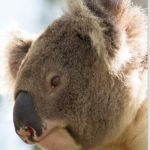
 There are significant things happening here in the forests surrounding us and I am excited to be at the very edge of it. Today was spent on my hands and knees in Mumbulla State Forest, in the rich soft soil at the feet of some of the eucalyptus and other great trees. What better place to be than in these coastal forests searching for evidence of koalas with a group of people passionate about habitat – wildlife and trees, about fire management, about the protection of these iconic beings.
I have never before been directly part of scientific research and am learning about the systematic and exacting methods of field study surveys. Strange as it may seem the only other volunteer today is also from Ontario, Canada, and works with textiles when not in the forests. How can this be?
There are eight of us bumping over old logging roads in two 4 x 4 trucks. We start with a grid sight, an area previously assessed in 2007-9 and 2012-14, and then radiate out to 30 trees, each being marked, identified and assessed for health and size. With meticulous care, the rich forest litter a meter from each trunk is searched by hand as we look for evidence of koala scat or that of other fauna from the forest. In this way an extensive record of biodiversity in the forests is gathered. The ground around 17,540 trees will be searched in this way by the end of September, taking a total of 1,200 person days. Data is recorded electronically in the field and sent to the koala database at the Institute of Applied Ecology at the University in Canberra. Scat, untouched by humans, is sent in specimen boxes.
Yes, it is the scientific methods of researching which is exciting and interesting. It is also being outside all day in the forest that appeals to me; but most of all it is the shared learning and passion of these few people who have worked, loved and lived to protect these forests over many decades, and continue to do so.
Working alongside Mark and Rob, I discover them to be a fund of knowledge. Their extreme generosity with this knowledge and experience is beginning to answer my naïve questions, or even help me understand what my questions are as I grapple with the issues and the history of these magnificent forests.
“Saving Our Species” is the NSW Government’s program to better manage threatened species. What’s shocking is to come to realize that the iconic koala is but one of 967 plants and animals listed as being threatened with extinction in New South Wales. 967 species. I realize I am having difficulty even hearing those numbers.
I learn more about these people’s lives, and connected today with David Gallan, realizing he is the director of a recently published DVD called UNDERSTOREY. The film is a powerful account of how intensive logging threatened these old-growth forests and how local people from all walks of life came together to oppose it. It took decades and saw many local people arrested for standing up for the forests and wildlife. Together, they stood against both the giant logging companies and the National Forestry Dept who in those years was supporting the extensive logging in the native forests.
I had seen the film recently; it opens up the story of these forests that surround us, and that I may otherwise have taken for granted and driven or walked through. I found myself amazed how in the middle of such intense struggle, over years, strategic information for the film was systematically recorded when the outcome was not known. I was equally struck that what may now see as essential conservation was then a struggle on very many fronts for these local people.
It is a story which repeats itself here and in many parts the world, as forests continue to be destroyed or be saved, to be clear cut or to be selectively felled.
Today the words of a song come to me as I sift through the soil at the foot of trees that are meant to support life for the animal species that we hope will return:
O Standing Nation
We sing to you
We breathe with you
We standby you
Story by Fenella Temmerman.