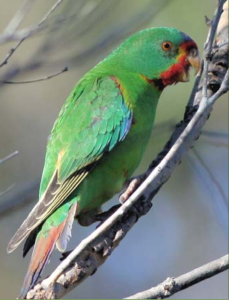
Swift Parrot – photo by Max Sutcliffe
Swift Parrots have begun their return trip to Tasmania where they breed, after spending winter in mainland Australia, feeding mainly on the nectar of eucalypt blossoms. The Far South Coast is an important feeding area for Swift Parrots, mainly due to the flowering of Spotted Gums here at this time of year.
Swift Parrots are listed as Endangered in NSW and Critically Endangered nationally. Annual surveys are undertaken to monitor their numbers and understand their behaviour. The second national Swift Parrot survey for 2017 is coming up this weekend, on 5-6 August.
BirdLife Australia is seeking volunteers to assist by searching for Swift Parrots in our local area. If you can do a survey on 5-6 August (or a week either side), they would love to hear of any sightings. Incidental sightings are also welcomed. Visit the BirdLife Australia website for survey information, including where to look for them locally and to download survey forms. A list of locations for the Eurobodalla and Bega Valley Shires is also provided below.
The Far South Coast Birdwatchers would also love to hear of any sightings in this area and can be contacted by visiting their website at www.fscb.org.au or emailing them at fscbirds@bigpond.com.
Recognising the Swift Parrot
The Swift Parrot is mostly bright green in colour, with dark-blue patches on the crown, a prominent red face, and the chin and throat are narrowly bordered with yellow. It is approximately 25 cm in length, the wingspan is 32 to 36 cm and it weighs about 65g. It is a slim, medium-sized parrot with angular pointed wings and a slender tail giving it the characteristic streamlined flight-silhouette.
This species is sometimes confused with lorikeets, most likely when seen flying overhead. In this situation the Swift Parrot is then best distinguished by calls, all of which are quite different from the harsh screeching or buzzing calls of lorikeets, and also by its slimmer build and distinctly longer finely pointed tail. No lorikeet has the combination of red underwing-coverts and undertail-coverts seen in the adult male Swift Parrot.
Swift Parrots are often noisy, active and conspicuous. They typically allow close approach when feeding in trees, and often associate with lorikeets and honeyeaters at abundant food sources.
Reference: Higgins, P.J. (ed.) (1999). Handbook of Australian, New Zealand and Antarctic Birds. Volume Four – Parrots to Dollarbird. Melbourne: Oxford University Press.
Far South Coast Swift Parrot Survey Locations
Potato Point/Eurobodalla National Park, Bodalla State Forest, Broulee,Moruya Heads, Moruya State Forest, Turlinjah, Tuross/Wagonga Inlet, Dalmeny, Narooma (Loader Pde, Narooma Caravan Park), Tilba area, Corunna/Mystery Bay, Wallaga Lake, Bermagui State Forest, Mimosa Rocks NP/Bithry Inlet, Tanja – surrounding bushland, Lake Wallagoot – surrounding bushland, Bournda NP, Tathra/Kalaru – streets, Merimbula/Tura Beach, Towamba, Kiah – bushland to the east of town, Nullica SF, Pambula/Bald Hills, Eden/Ben Boyd NP/Nadgee.